
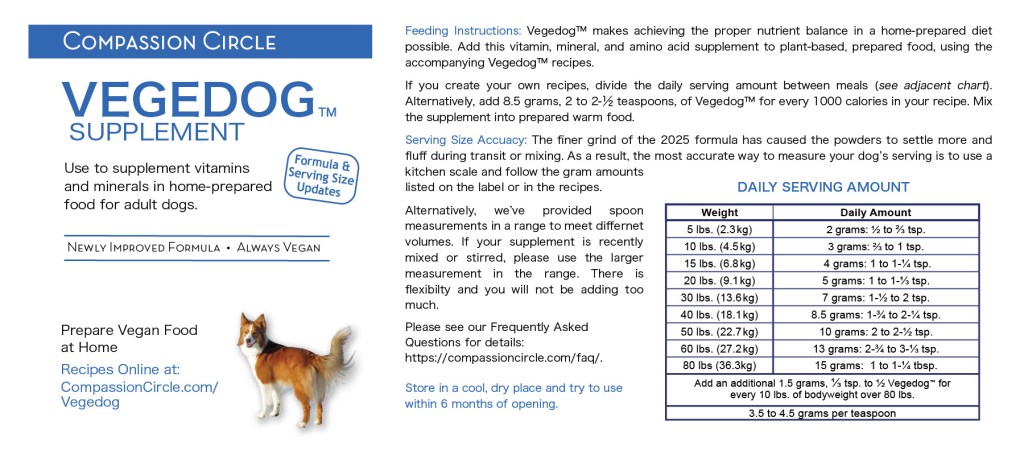
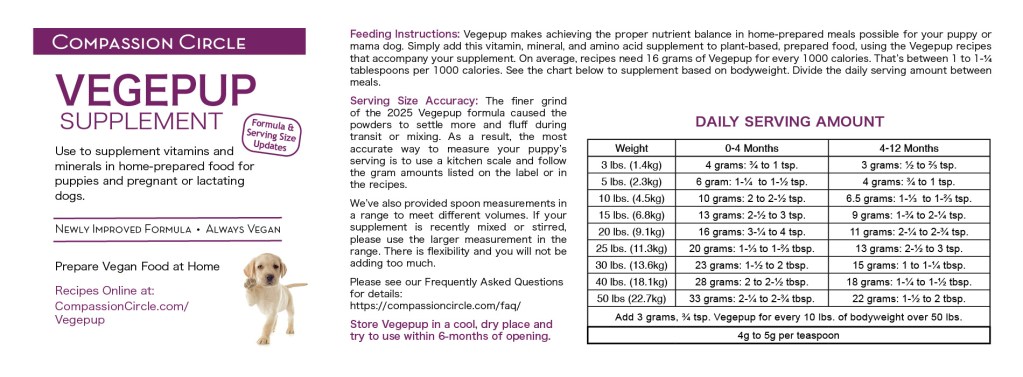
We’re finding that the volume of our Vegedog and Vegepup supplement has changed since our initial serving size measurements. The finer grind of the 2025 formula has caused the powders to settle more and fluff during transit.
As a result, the most accurate way to measure your dog’s serving is to use a kitchen scale and follow the gram amounts listed on the label and in the recipes.
If a kitchen scale isn’t available, you may need to increase the spoon (teaspoon or tablespoon) measurement by up to 20% to ensure your dog receives the intended daily amount.
To add 20% to any number:
Multiply by 1.2
Example:
If your recipe calls for 1¾ teaspoons, calculate
1.75 × 1.2 = 2.1 teaspoons
So, you would feed about 2 teaspoons instead.
This adjustment applies only to the dog supplements (Vegedog and Vegepup) purchased in 2025. The Vegecat formula has not been affected — its serving size and density remain largely consistent.
PLEASE DON’T WORRY! Even at the lower spoon-based amounts (if your supplement did aerate and fluff), our serving sizes included a safety margin to ensure your dog received more than the minimum daily nutrient requirements. Adjusting the serving amount now brings you back to the optimal range.
Please find a more detailed explanation of the texture and serving size variations in the communication we sent to all 2025 dog supplement users: Download HERE [PDF].
The updated serving size chart for Adult Dogs:
Download the Vegedog Recipe Brochure [pdf Download]
Download the Vegedog Guide to Dr. Pitcairn’s recipes [pdf Download]
The updated serving size chart for Growing Puppies:
Download the Vegepup recipe brochure [pdf Download]
Download the Vegepup Guide to Dr. Pitcairn’s recipes [pdf Download]
AreIf you purchased Vegepet product (Vegedog, Vegecat, or Vegepup) in 2025, the use by date is the end of January 2027. The date of manufacture is on the bottom of the bottle, however faint, and the “use by” date is two years from that date.
The other products have the “use by” date on the bottle or bag rather than the manufacture date.
The updated Vegedog™ and Vegepup formulas now feature increased levels of the amino acids taurine and methionine, the addition of L-carnitine, higher choline content, additional B vitamins, and enhanced mineral sources using amino acid chelates. After much consideration, an additional raw material change is a return to bioavailable selenium yeast as our selenium source. You will truly be getting the best human-grade, non-GMO, experience-backed formula possible.
Please note that our use of selenium yeast does mean that Vegedog™ and Vegepup (and Vegecat™) are no longer yeast-free. To uphold our commitment to quality, we changed our selenium source back to selenium yeast, as the synthetic alternative did not meet our high standards. While the amount of selenium yeast in the supplements is minimal—less than 4mg per gram for puppies and 5.4mg for adult dogs—and may not affect dogs with a yeast intolerance, we cannot guarantee its suitability for dogs with yeast allergies. We sincerely apologize for any inconvenience this may cause. If you need assistance formulating a yeast-free, home prepared diet, please contact an animal nutritionists from our Resources page.
With these new supplements, you will no longer need to add food yeast to your dog’s meals to supply B vitamins. Vegedog and Vegepup contain the B vitamins previously derived from food yeast. These additions include: niacin, thiamine, pantothenic acid, and pyrodoxine. The supplements already contained riboflavin and B12. These B vitamin sources are yeast-free, so they are not contributing to the small amount of (inactive) saccharomyces cerevisiae yeast in the supplements.
We’ve kept food yeast (VegeYeast or nutritional yeast) in the Vegepup recipes to maintain the nutrient and calorie density. It’s important that puppies can get the calories they need from the amount of food they are able to eat. If you leave the food yeast out of recipes, or rely on the oat recipes (only found online), you might need to add an extra meal in the day to be sure your puppy eats enough calories.
You are still welcome to add VegeYeast (or nutritional yeast) to your adult dog’s diet for flavor, protein, other nutrients, and acidity, but it will not be necessary for complete nutrition.
To ensure we are able to continue providing the highest quality supplements for your family, our new formula supplements have an increased cost. From the time we took over this product line over a decade ago, up through the present, our profit margin has not been particularly sustainable. We want this ideal feeding option available to all and have gone to great lengths to make that a reality. During that time, production and business expenses have increased and our rescue expenses have similarly grown. Our founder has not only paid most of our rescue expenses out-of-pocket but also a number of business expenses. In fact, it’s difficult to convey the extent of the sacrifices she’s made for the greater good at her own expense. We’ve reached a point where the Vegepet product line must pay for itself. To that end, our price increases might be a little jarring but we assure you they are the minimum necessary, and still low in relation to our cost by industry standards. Our new prices are still highly competitive among other vegan supplements and the cost of the Vegedog™ and Vegepup diet is still competitive among commercial vegan foods.
One last change was a size change. Please keep that in mind when price comparing, and remember you no longer need to purchase VegeYeast or food yeast to use with Vegedog™, so that is a cost counterbalance.
We appreciate you understanding our goal is simply to stay in business and provide your companion animals the the best human-grade, non-GMO, experience-backed formula possible, so they can thrive. Well, our goals are also to spread compassion and veganism and rescue animals in need and do what we can to help save the environment, but you know what we mean. 😉 💖
The new formula Vegecat™ contains increased levels of the amino acids taurine and methionine and the vitamin choline. The amino acid L-carnitine is also added to the formula for heart health and general well being.
There are also improvements to the nutrient sources. Minerals are now supplied by more bioavailable amino acid chelates and our selenium source is selenium yeast. We know yeast is an issue for a minority of cats with yeast intolerance and we sincerely apologize to those of you this might impact. The amount of yeast per grams is small, less than 2.8mg. That’s roughly 8mg of yeast per day for an 8lb cat or 11mg per day for a 10lb cat. Ultimately, we just had to go with the greatest good for the greatest number principle and move to the most ideal selenium source.
If you are also feeding a dog, you might wonder why food yeast is no longer needed in dog meals but is still needed in the Vegecat™ diet. We did not add additional B vitamins to Vegecat™ because the acidity from VegeYeast is a crucial part of a plant-based diet for cats. The alkalinity of a plant-based diet needs to be countered by the acidity of our modified VegeYeast. For that reason, food yeast for B vitamins (and acidity and flavor) is still required in conjunction with Vegecat™ in the Vegecat™ diet.
One other change is a change to the size offered. To meet manufacturing minimums, we consolidated the former two Vegecat™ size offerings into one 14oz (400g) supplement that will last an 8lb cat about 130 days and a 10lb cat about 100 days.
Finally, our prices have increased in a somewhat jarring way. After a decade of resisting real price increases, we simply can’t stay in business without increases that are in line with the rising cost of manufacturing and doing business. We certainly hope you are able to work our unique, non-GMO, human grade, time tested supplements into your budget. We want feeding a plant-base, home-prepared diet to be an option for all. If you use bulk ingredients, most of our recipes, with the supplement added, can be made for $3.50-$5.00 and those will last one cat a few days. That is less than commercial vegan food and, in our opinion, the absolute healthiest option.
Please know that we’ve only increased prices as much as we had to, to keep producing this unique product, and our other products that allow cats and dogs to eat the best diet possible.
We do not package samples. We suggest preparing the recipes without adding the supplement if you would like to see how your dog or cat accepts the food or would like to find out what is involved in preparing meals. The supplement adds the vitamins and minerals needed for complete nutrition but it does not change the taste of the food significantly.
Products should be stored in a cool, dry place. Keep the lid tightly closed. Do not refrigerate. The moisture in the refrigerator is not desirable and should be avoided. Once opened, it is ideal to use your supplement within 6-months. It will not go bad but there is some vitamin loss over time.
It’s best to not only keep the packet in your supplement but to refresh it when it can no longer absorb moisture. Even when storing products in a cool, dry place, some moisture from the air can enter the product. If your supplement begins to clump, moisture is no longer being absorbed by the desiccant. This can increase the odor of the supplement.
You may refresh the packet by heating for 2-3 hours in convection oven at 200-240F or in the microwave on LOW power from 30 seconds to 2 minutes. DO NOT place in oven over 250F. (Times are estimates, monitor when recharging.)
Vegepet supplements are to be used within 2-years of manufacture. You will find an expiration date on every product. The shelf-life of the superfood products have a longer shelf-life. Please check the bottle. Green Mush™ can be used well beyond the FDA required “use by” date on the bottle.
It’s ideal to use your supplement within 6-months of opening, but you may use it though the expiration date. Oxygen exposure will intensify the smell over time. There is also some vitamin loss over time and with oxygen exposure.
Store in a cool, dry place.
These are rough estimates. If you add the supplement as instructed in our recipes, rather than using the daily serving size on the label, the product will probably last a while longer.
Vegecat 14oz:
5lb cat – 200 days
8lb cat – 130 days
10lb cat – 100 days
Vegedog 14 oz:
10lb dog – 133 days
30lb dog – 57 days
50lb dog – 40 days
Vegedog 25 oz:
10lb dog – just under 8 months, so not recommended unless you’re feeding multiple dogs.
30lb dog – 101 days
50lb dog – 71 days
80lb dog – 47 days
120lb dog – 34 days
Vegepup: The amount varies a great deal depending on age, weight, recipe ingredients, and more.
If you follow our recipes, you’ll use roughly 48 grams of Vegepup for every 3000 calories of food, or 16 grams for every 1000 calories. You can use the following calorie calculator to determine how many calories you’ll feed over time: http://vetcalculators.com/calories.html.
Vegepup contains 400 grams.
VegeYeast:
Cat – 1lb will last between 5 to 7 weeks.
Dog – 1lb will last a 10lb dog as long as 5 months, a 30lb dog about 2.5 months, a 50lb dog about 7 weeks, and a very large dog less than 1 month.
Puppy – 1lb will last a small puppy as long as 4 months and a large puppy as little as 7 weeks.
Green Mush:
The recommended serving sizes are: rats – 1/8 teaspoon; cats/rabbits – 1 teaspoons (2 grams); small dogs (5-20 lbs.) – 1-2 teaspoons (2 grams – 4 grams); large dogs (45 lbs. or more) – 1 tablespoon (6 grams)
The 10 oz Green Mush contains 142 teaspoons or 47 tablespoons.
The 5 oz Green Mush contains 71 teaspoons or 23 tablespoons.
The trial size Green Mush contains 10 teaspoons and or little over 3 tablespoons.
NO! Our products do not contain GMOs and we encourage you to use non-GMO ingredients. If corn, soy, wheat, and canola is produced in the USA and is not organic, it is almost certainly genetically modified. Please buy ORGANIC for your animal companion and yourself!
No. Commercial food should be nutritionally complete on its own. Adding the vitamins and minerals in the Vegepet supplements to an already nutritionally complete food can cause over supplementation. The Vegepet supplements are not a multi-vitamin, they are a combination of nutrients missing from home prepared diets.
If you are interested in a multi-vitamin product, please look into our superfood Green Mush™. This product is whole-food based and loaded with bioavailable nutrients and a powerful, natural antioxidant (CoEnzymeQ10). Green Mush™ is great for both you and your companion animal. The algae, grasses, sea vegetables, and other ingredients are organic and/or pesticide free and from the purest sources.
Yes, absolutely. You’ll find daily recommendations on the product labels. You can take a look at those labels from the product pages in the Shop.
Yes, please do!
It is ideal to use both a Vegepet supplement (Vegedog™, Vegepup™, or Vegecat™) and Green Mush™ in your home prepared food. The Vegepet supplement will fill in the nutritional gaps in your home prepared food, supplying vitamins, minerals, and amino acids. Green Mush™ provides all food-based, bioavailable nutrients like phytonutrients and antioxidants. Green Mush™ goes beyond the basics to reduce inflammation, detoxify, and support the immune system and body generally. All home prepared food should contain a Vegepet supplement (or a number of individual supplements) and all diets (commercial or home prepared) benefit from the addition of Green Mush™.
Yes, absolutely! Your body will thank you.
Green Mush™ contains the finest human-grade ingredients available. The product is pesticide-free, non-GMO, gluten-free, vegan, and superior to most human superfood supplements. Humans benefit greatly from the array of bioavailable nutrients and antioxidant properties Green Mush™ offers. Antioxidants reduce inflammation in the body and a number of health issues stem from inflammation and chronic inflammation, whether you’re a dog, cat, human, or otherwise. Green Mush™ also assists the body’s detoxification efforts. To read more, download the Green Mush Whitepaper.
So, yes, do it!
Green Mush™ is an array of cleansing superfoods, phytonutrients, protein, and amino acids. It is a superb source of a wide spectrum of trace minerals and organic nutrients that are only found in whole foods.
We do not consider Green Mush a major source of the vitamins and minerals typically found on a nutritional panel. The benefits of Green Mush come from things like the antioxidant properties of phycocyanin in spirulina, chlorophyll that oxygenates the blood and increases energy production, the phytonutrient Chlorella Growth Factor (CGF) that supports RNA/DNA functions, and more. The benefits of these superfoods culminate in immune support, optimal liver and kidney function, detoxification, reduction of inflammation, etc.
The tested vitamins and minerals in one teaspoon of Green Mush (2g) are as follows.
Calories 7.4
Protein 720mg
Fat 120mg
Iodine 0.1572mg
Calcium 24mg
Magnesium 8.8mg
Phosphorous 13mg
Potassium 40mg
Sodium 9.6mg
Omega 3s 16mg
Omega 6s 16mg
It’s best if you don’t.
VegeYeast is human-grade but it is modified to be especially acidic. Companion animals need to maintain an acid pH and benefit from VegeYeast. It is best for humans to maintain an alkaline pH.
The pH of VegeYeast is 4.0. Most food yeast has a 5.5-6.0 pH.
Yes. All home prepared diets tend to be lacking in nutrients like Calcium, Vitamin A, Vitamin D, and more. Vegepet supplements fill in the gaps for plant-based and meat-based diets, though we highly recommend a plant-based diet. Follow the daily serving size chart on the label.
Vegedog is a very good substitute for bone meal! The calcium to phosphorous ratio in Vegedog is the same as in bone meal, 2.5 to 1.
For more than 30 years, Dr. Pitcairn’s Complete Guide to Natural Health for Dogs & Cats has been the go-to resource for health-conscious animal lovers. The authors, Dr. Richard Pitcairn and Susan Pitcairn, have long been the trusted name in holistic veterinary care and continue to be at the forefront of natural pet health. The fourth edition of Dr. Pitcairn’s Complete Guide to Natural Health for Dogs & Cats, published March of 2017, is updated with the latest information in natural pet health, including groundbreaking research on the benefits of vegan diets for dogs and cats. Vegepet supplements feature prominently in all of the book recipes. We think that qualifies as an endorsement and are honored to be a part of this paradigm shift!
Further, a number of veterinarians around the country have started carrying our products in their offices and recommending their use.
As a veterinarian being concerned with the animal’s health, it is very encouraging to observe their health improving in many cases after being on the new regimen.– Michael Lemmon, DVM
The following was quoted regarding the Vegepet founder’s book, Vegetarian Cats & Dogs, that discusses the Vegepet diets and supplements.
Vegetarian Cats & Dogs is a solid work of ethical integrity and is meritorious as an example of applying scientific information to progressive ends. The scientific rationale is as sound as the moral arguments are incisive and persuasive. The author is sincere in his commitment to a scientifically sound means to feed dogs and cats with superior nourishment (meeting all the known nutritional requirements for different stages of life), while at the same time reducing large scale animal suffering in agribusiness.
-British trained veterinarian David H. Jaggar reviewing Vegetarian Cats & Dogs by James A. Peden. The book documents the research that produced the Vegepet™ products.
We no longer resell the digestive enzyme product Prozyme® Plus, in part, because the producer changed their resale policy. That product is still available from larger sellers. Please note that only the supplement with “Plus” in the name is vegan.
We are happy to have discovered Enzyme Miracle® from Nusentia®. It is a more comprehensive option than Prozyme® Plus. Due to the wider variety of enzymes in Enzyme Miracle® — for the digestion of protein, carbohydrates, and vegetable matter — it is better formulated for vegan companion animal diets.
We now also carry the Animal Essentials product Plant Enzymes & Probiotics. The product also supplies probiotic and is a good choice to both aid digestion and support overall gut health and immunity.
Please give it a try and let us know what you think!
For dogs, mix a small amount of the new food with the old and adjust the proportions over a period of days to a week. You can begin with 25% new food, or less. Dogs rarely need enticing.
For cats, mix a small amount of the new food with the old and adjust the proportions over a matter of weeks. You might need to begin with as little as a teaspoon of the new food in the old and work up from there. If necessary, you can mix pulverized commercial kibble into recipes.
Most animals thoroughly enjoy their vegan food, but some cats can be a little finicky. Some palatability enhancers for cats include: crumbled nori flakes, dried catnip, vegan sausage or mock meat (a small amount of onion or garlic is okay but do not use a mock meat with more than a flavoring), algae, pureed corn with kelp flakes/nori or canned pumpkin and nutritional yeast. If your dog is resistant, try watering down a nut or seed butter and adding that to meals. Use almond butter, peanut butter, sunflower butter, or tahini, but NEVER use a product that contains xylitol. A little nut/seed butter goes a long way.
Please be aware that cats can become addicted to the “digest” derived flavoring in commercial cat food. Digest is made from the entrails of chickens and flavored in various (unsavory) ways. If you are switching the diet from a commercial food, please be mindful that your cat might need to break the addiction to digest before objectively accepting the new home prepared food. Be patient and allow your cat to show you how quickly the transition can be made.
If the supplements themselves seem to be a palatability issue, you may introduce a little at a time, begin with as little as 1/4 the recommended amount, then work up to the full amount over a week or more. It’s okay for dogs to eat unsupplemented, or inadequately supplemented, home-prepared food for a few weeks to a month if necessary. Cats need proper supplementation regularly on a vegan diet so we don’t recommend this gradual introduction of Vegecat™ for more than about a week in an entirely home-prepared diet.
Find out how many calories to feed your dog, cat, or puppy per day based on age, weight, and whether they are spayed/neutered at this link: http://vetcalculators.com/calories.html.
Follow our recipes, adding the amount of supplement as instructed in the recipe, and you’ll have nutritionally complete food. Each recipe lists the number of calories contained in the entire recipe under the recipe title. Measure how many cups your prepared recipe yields. Divide the total number of calories by the number of cups you measured. That answer is the number of calories each cup of food contains. For example, if the entire recipe contains 3000 calories, and you end up with 8-1/4 cups of food, your recipe contains 363 calories per cup [3000 ÷ 8.25 = 363].
You can enter the calories per cup, along with your animal’s weight, on the calorie calculator website to find out how many cups to feed per day. Once you have the number of calories per cup in the food, you simply divide the number of calories your cat/dog/pup needs per day by the calories per cup to find out how much to feed. For example, if you determine your food has 285 calories per cup, and you are feeding a dog that needs 1150 calories per day, you’ll need to feed 4 cups of food per day [1150 ÷ 285 = 4.03].
If you are feeding a growing puppy, check the calorie calculator often to be sure you are feeding the right amount. You want to enter the ideal weight for your adult dog or cat, rather than the current weight if they are not at their ideal weight.
If it wasn’t for science it wouldn’t be possible to feed cats vegan. However, we now know what nutrients are necessary for cats to thrive and we can obtain those nutrients without killing other animals. Taurine is a good example. This is a vital amino acid that almost all mammals synthesize from other amino acids, but cats lost that ability thousands of years ago. Taurine is available in synthetic form from non-animal sources and works as well as that from animal flesh.
Another nutrient is a fatty acid that is extremely rare in the vegetable kingdom but necessary for cats, arachidonic acid. Vegecat supplies arachidonic acid in a vegan form commonly used in human infant formula.
Vegecat has been available since 1986 and many of our clients from the early years have stayed with us as their cats age and they welcome new generations of cats into their families. Not all cats immediately take to the new diet, and often it is necessary to make a lengthy transition from the old food to the new, by mixing a little of the new gradually into the old food. Sometimes, enticements such as pureed nori and corn are necessary, but the transition can be done!
The argument that a vegan diet for companion animals is “not natural” is highly suspect when many are feeding beef to Chihuahuas or ocean fish to cats and confining them to indoor living. We’ve domesticated our animal companions, and very little of their formerly “natural” lives remain. Long ago, dogs began producing a digestive enzyme (amylase) for digesting carbohydrates at a much higher rate than their wolf ancestors.
There are certainly drawbacks to meat-based diets, raw or commercial. Contaminants such as heavy metals, pesticides, additives, industrial chemicals, flame retardants, etc., accumulate in the fat tissues of animals. Heavy metal concentrations have been found to be higher in animals eating at the top of the food chain. Fish that eat other fish are especially toxin-laden and are routinely fed, as fish meal, to other fish, poultry, livestock, and cats. “It has been found that carnivorous species bioaccumulate far greater quantities of [heavy] metals than herbivores or omnivores.”* One way to potentially minimize contaminants in your companion animal’s diet (or your own) is to eat a plant-based diet.
For a more in depth view of the issues surrounding available food for pets and people, we encourage you to read Dr. Pitcairn’s Complete Guide to Natural Health for Dogs & Cats (4th edition); specifically, Chapter 2: What’s Really in Pet Food and Chapter 3: What’s Happening to All Our Food. You can request the book at your local library, order it in our shop, or find it most anywhere books are sold.
* Jakimska, Anna et al. “Bioaccumulation of Metals in Tissues of Marine Animals, Part II : Metal Concentrations in Animal Tissues.” (2011).
For more about the toxic chemicals discovered in the blood and urine of pets (unrelated to diet), read “Polluted Pets” on the Environmental Working Group website.
For more perspective on what is and is not natural, we suggest reading Dr. Andrew Knight’s article Vegan Pet Food: Fishy Business?
Most cats do perfectly well on the standard Vegecat™ diet when VegeYeast is also used. VegeYeast is always recommended for cats to increase the acidity in the diet and prevent alkaline urine.
Cats should have an acidic urine pH of 6.0 to 6.5. It is wise to test the urine at home or at a vet’s office before switching the diet and about 3-weeks after transitioning to a new diet, then periodically after – twice in the first year and once per year after. If alkaline urine is a problem, you have options. Acidifiers include cranberry powder, ascorbic acid (vitamin C), and the amino acid methionine. If urine pH is higher than a 7.0, you can use one of the following: 1 teaspoon of cranberry powder per day, up to 500mg of vitamin C (ascorbic acid) per day, or ask your vet to recommend the correct amount of methionine for your cat’s size.
To test urine pH at home, use only a small amount of litter in the litter box. Urine can then be collected in a corner and tested with an over-the-counter pH test strip. Alternatively, a regular amount of litter in the box can be covered with plastic wrap, allowing urine to pool on the plastic and be tested. There is also non-absorbent cat litter than can be used in place of standard litter or Pretty Litter, that changes color when to indicate if the litter is too alkaline or too acidic. Of course, a vet can do the urine testing as well and that might be necessary when multiple cats use the same litter box. Test strips (intended to monitory human pH) can be purchased over-the-counter at a pharmacy.
The more water and moisture in the diet, the better the urine concentration of your cat. Feeding primarily wet food recipes can prevent urinary issues. If kibble makes up the majority of a cat’s diet, it is best to add pureed vegetables or water to the kibble.
Urinary issues occur in cats eating any diet. These concerns are not unique to a plant-based diet. Cats on a meat-based diet benefit from periodic urine testing as well.
We regret that we had to discontinue the Vegekit™ supplement for kittens and lactating mamas some time ago due to regulatory issues surrounding a necessary ingredient.
The Evolution brand sells ready-made, vegan food for growing kittens. The products they market for kittens say “for all life stages” on the packaging. We can’t speak to the nutritional adequacy ourselves but encourage you to reach out to the company for more information.
Please do not use the Vegecat™ supplement for kittens under 10- to 12-months old. In addition to a kitten’s higher arachidonic acid requirement, they have higher nutrient levels than adult cats when it comes to a number of nutrients. Some of these higher requirements include: protein, amino acids, calcium, phosphorous, magnesium, copper, iodine, and vitamin A. Please choose a ready-made food that will accommodate these needs.
The complex carbohydrates in our recipes are largely comprised of the starchy portion of the plant and can be broken down in digestive tract. It is best to soak legumes and fully cook the legumes and grains. Recipe ingredients can be blended for even better digestion, separately or after the meal is fully prepared.
Cats have the ability to use carbohydrates as energy but there is enough protein and fat in the recipes that energy production can come from those better utilized sources. It is very beneficial for cats eating carbohydrates to be given a digestive enzyme product that includes amylase for breaking down carbohydrates. The added enzymes greatly increase nutrient absorption and aids digestion.
Dogs produce their own amylase for the digestion of carbohydrates. Nevertheless, we highly recommend adding a digestive enzyme product to all cooked or processed food because enzymes are heat sensitive and destroyed when heated or over-processed.
The general consensus among regulating bodies is that synthetic taurine is assimilated in the same manner as natural taurine. The AAFCO and European Food Safety Authority both hold that synthetic taurine in the diet of cats and dogs is efficacious and can be used as a reliable taurine source. The majority of commercial cat and dog foods add synthetic taurine because natural taurine is denatured during high-heat processing. As much as 50% to 70% of the taurine from meat is lost in the processing of commercial cat food. So, there is a huge sample of cats lacking signs of taurine deficiency during a lifetime of consuming and utilizing primarily synthetic taurine.
Some raw foods and wet foods that are not extruded or processed at high-heat retain natural taurine, but extruded dry foods and foods relying on bi-products (lacking muscle tissue) result in a taurine deficiency without the addition of synthetic taurine. In the 1960s, the very sad reality was that dry food companies were not adding synthetic taurine to their food and many cats died due to a deficiency. After synthetic taurine was added, the deaths stopped.
The taurine in Vegecat supplies about 224 mg per day for a 10 lb cat, or that amount for every 300 calories. The AACFC standard requires 150 mg for 300 calories of food.
Taurine is not an AAFCO required nutrient for dogs. The NRC (National Research Council) recommends about 200 mg of taurine per 1000 calories of food for grown and growing dogs. The Vegedog™ supplements supplies a 45 lb dog who eats 1350 calories per day 972 mg of taurine (or 718 mg per 1000 calories).
The Vegepup supplement supplies a 15 lb puppy eating 490 calories per day 450 mg of taurine (or 918 mg per 1000 calories).
L-carnitine is contained in Vegedog™, Vegepup, and Vegecat™ manufactured in 2025 onward.
L-carnitine is not an AAFCO required nutrient for dogs or cats. Prior to 2025, our supplements provided the building blocks of L-carnitine.
The amount of L-carnitine in the Vegepet supplements is roughly half of the amount of taruine. Please see the previous taurine entry to gauge the amount of L-carnitine in various diets.
The quantities in the supplements are as follows:
Vegedog 5.4%, or 54mg per 1g
Vegepup 2%, or 20mg per 1g
Vegecat 2.7%, or 27mg per 1g
VegeYeast is a modified brewers yeast that adds B vitamins and protein to the diet. VegeYeast is more acid than other food yeast, such as nutritional yeast, and is lower in magnesium. The extra acidity in VegeYeast is valuable for both dogs and cats, and a diet low in magnesium is thought to lessen the likelihood of struvite crystal formation.
VegeYeast is the dried, non-fermentative, non-extracted yeast of the botanical classification saccharomyces resulting as a co-product from the brewing of beer and ale. These pure strains of saccaromyces cerevisiae are grown on mixtures of cane and beet molasses to make VegeYeast. Yeasts are single-celled fungi. Yeasts are as natural as fruit and vegetables.
It has recently come to our attention that the modification to lower the pH of VegeYeast involves the use of hydrochloric acid (HCl). Hydrochloric acid is a stomach acid and additive used in food processing. The negligible amount of HCl in the whole diet is considered “an incidental additive” by AAFCO. The HCl used in the yeast processing, prior to the kill step that inactivates the yeast, is vegan. This is the same yeast used in the Vegepet diets since the 1980s and, seemingly, a necessary part of lowering pH to provide additional acidity. We’ve found the yeast crucial to some cats’ diets over the years and quite safe.
The pH of VegeYeast is 4.0 or lower.
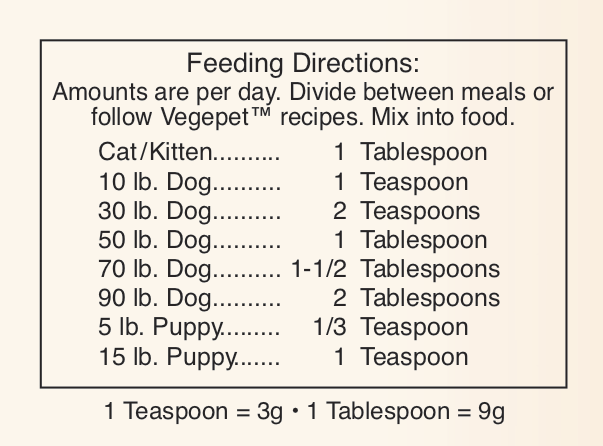
If you are not following one of our recipes or one of the Pitcairn’s recipes, add the following amount of VegeYeast to the diet per day. You can use the same amount of brewer’s yeast or mini-/crushed nutritional yeast flakes. If your nutritional yeast flakes are large, double the volume called for or crush them prior to measuring. For example, use 2 tablespoons rather than the 1 tablespoon called for in the chart, but that will still be 9 grams of food yeast. Your measurements don’t have to be exact, but please use the chart as your guide.
Beginning in 2025, the Vegepet supplements (Vegedog, Vegepup, and Vegecat) contain a small amount of inactive yeast because the selenium source is selenium yeast. The small amount could be enough to prevent some dogs and cats with yeast intolerance from using the supplements. The amount that triggers a reaction is not known.
Vegedog contains less than 5.4mg per gram, Vegepup less than 4mg per gram, and Vegecat less than 2.7mg per gram.
Otherwise, you can remove the food yeast from dog recipes and they will still have the needed B vitamins. You might consider adding ascorbic acid or cranberry powder for acidity if your dog has a history or urinary issues/alkaline urine.
If your cat can tolerate the amount of selenium yeast in Vegecat™ but needs to limit the yeast in the diet that supplies B vitamins, you can omit the yeast in recipes and substitute a B-complex vitamin. Crush a tablet and mix in with food. One 50 mg B-complex tablet will suffice for a week’s worth of food for a cat. Any excess B vitamins are eliminated through the urine because B vitamins are water soluble.
Examples of B Complex vitamin options are the NOW brand B-50 tablet or the Solgar B-Complex 50.
For cats and dogs, most food allergies are related to animal products.
For dogs, the most common allergens are beef, dairy, wheat, chicken, lamb, soy, pork, rabbit, and fish (in that order).
Wet food recipes for dogs can be made without either wheat or soy. However, all but the legume recipes require one or the other as a protein source. The Dog Garbanzo Recipe and Lentil Recipe are free of both wheat and soy.
For cats, the most common allergens are beef, dairy, and fish.
The superfoods in Green Mush can offer general immune support, support organ systems like the kidneys and liver, reduce inflammation in the body, improve the skin and coat, and oxygenate the blood to help detox cells. That said, we do not consider Green Mush a significant source of the vitamins and minerals typically found in a nutrition panel. You should not rely on Green Mush to fill in the nutritional gaps in home prepared food, but it is a wonderful addition to any diet; loaded with antioxidants, chlorophyll, detoxifiers, phytonutrients, trace minerals, and more.
Because we do not consider Green Mush a significant source of the following nutrients, we do not test each batch for vitamin and mineral content. The following is a compilation of various tests in the last few years and is fairly accurate for each batch.
Nutrition Facts in 2 grams (1 level teaspoon) of Green Mush:
Crude Protein: 36%
Crude Fat: 6%
Calcium: 24mg
Phosphorous: 13mg
Potassium: 40mg
Magnesium: 9mg
Sodium: 9.6mg
Iodine: 0.1572mg
Omega 3s: 16mg
Omega 6s: 16mg
Calories per teaspoon (2g): 8 calories
While flax and hemp products supply omega 3 and omega 6 fatty acids, the body must convert omega 3s into DHA and EPA. This is not an efficient process and it’s great if you choose to supplement the diet with DHA and EPA.
You’ll find an organic, potent DHA + EPA option in our Shop: Vegan Omega-3, 6, 9s Algae Oil for Dogs & Cats
Otherwise, there are a number of algae-sourced omega 3 supplements on the market to supply DHA and EPA. It is perfectly okay to use human supplements, but please be sure the supplement you choose does not contain excessive amounts of vitamin D or vitamin E. Some human supplements have levels of vitamin D or E that are too high for your dog or cat. A small amount of vitamin E is okay.
A few supplement softgel options include Nordic Naturals Algae Omega softgels, Doctor’s Best Vegan DHA from Algae softgels, Dr. Fuhrman’s DHA + EPA oil, and Source Natural’s Vegan Omega-3s softgels. Again, this list is not exhaustive. Softgels can be opened and added to food.
The amount of DHA + EPA recommended for cats and dogs varies a great deal from one source to the next. We recommend consulting your vet or an animal nutritionist for a recommended amount.
Digestive enzymes break down protein, carbohydrates, and fat so the body can absorb the nutrients from food. These important enzymes are produced in the body and consumed in raw foods, but digestive enzymes are destroyed when food is heated or processed. Adding enzymes to the diet is hugely beneficial for digestion and nutrient absorption. This is especially true for cats and dogs eating a plant-based diet. These digestive aids allow the body and immune system to spend less energy on digestion and more on other important tasks.
Probiotics are beneficial bacteria present in the gut to counterbalance harmful bacteria, among other functions. The body does not make probiotics. They must come from the environment. A healthy, balanced gut supports digestion, immune function, and more. Since probiotics are found in the soil, many animals have a fairly healthy supply.
Udo’s Choice does a very good job elaborating on the this in their article, “Enzymes vs. Probiotics: Why We Need Both.”
Compassion Circle highly recommends adding a digestive enzyme product to your animal’s diet.
If you have reason to believe your cat’s or dog’s gut microbiome is out of balance, due to infection, antibiotic use, poor immune function, poor digestion, or a specific health issue, adding probiotics to the diet is wise. Science is discovering more and more how immune function, and even brain function, is linked to the gut microbiome.
While our Green Mush™ superfood contains a digestive enzyme blend, the amount is minimal and intended to enhance the bioavailability of only that supplement. We do not consider Green Mush an adequate source of digestive enzymes or probiotics.
For a combination of probiotics and digestive enzymes, please check out our resale product: Plant Enzymes and Probiotics
For a great pure digestive enzyme product, please find Enzyme Miracle in our Shop.
(Both links go to the smaller product. There is a larger available, too.)
We encourage you to use organic ingredients! The health risks of genetically modified food and the herbicide glyphosate are just too great to ignore.
While most grocery stores will have most or all of the ingredients you need, check with your local co-op or natural grocer. Many will sell you large quantities from the bulk department and order ingredients they might not have. Asian grocery stores are a good place to find tofu and other ingredients.
For bulk legumes, grains, oils, flours, nutritional yeast, and more:
essentialorganicingredients.com
For organic Textured Soy Protein (TSP):
For non-GMO Textured Soy Protein (TSP):
For House Foods Organic Tofu, search sellers on their website:
House Foods Organic tofu is a great tofu option, available at Trader Joe’s and many other locations. Mori-Nu Silken Tofu is a non-GMO tofu that is also made without a magnesium coagulant.
While we don’t love big box stores (like Walmart and Target) or Amazon.com, those places are increasingly offering organic options. Thrive Market also seems to be a source of many of the ingredients needed in the Vegedog, Vegepup, and Vegecat recipes. We haven’t signed up to look into that further, but you can if you’re interested (Thrive Market Link).