Vegepup Recipe Instructions
START WITH FRESH INGREDIENTS AND PREPARE FOOD AS YOU DO FOR OTHER FAMILY MEMBERS.
HOW MUCH SHOULD YOU FEED?
Ask your veterinarian, or use a reputable on-line calorie calculator, to determine how many calories to feed your puppy or dog per day, based on age and weight.
One on-line calculator we really like is Vetcalculators.com.
Be sure to weigh your puppy regularly and adjust the number of calories you are feeding. Puppies under about 4-months of age need more calories per pound of body weight than older puppies. Be sure to check the calorie calculator for a new calorie recommendation when you hit the 4-month mark.
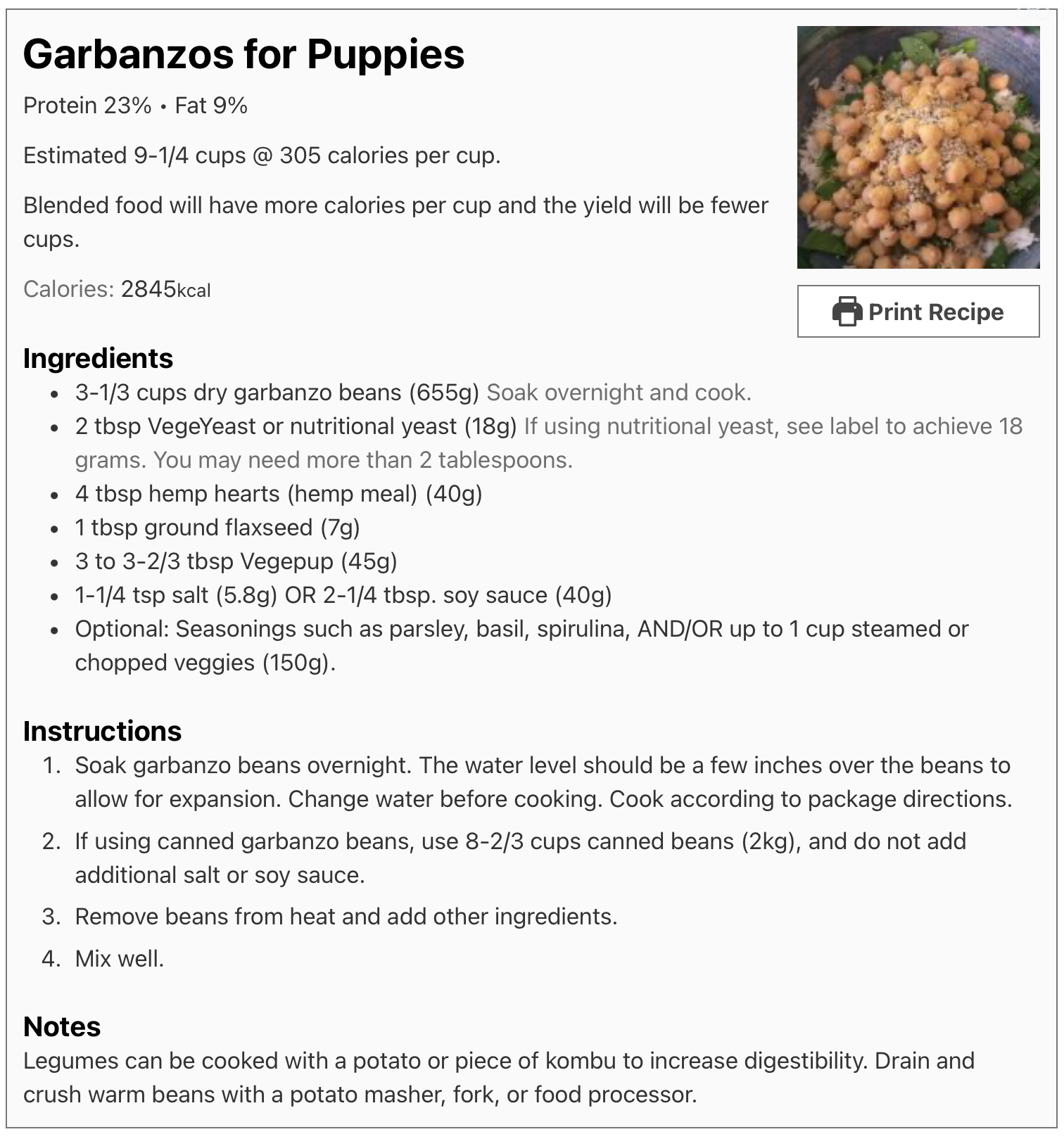
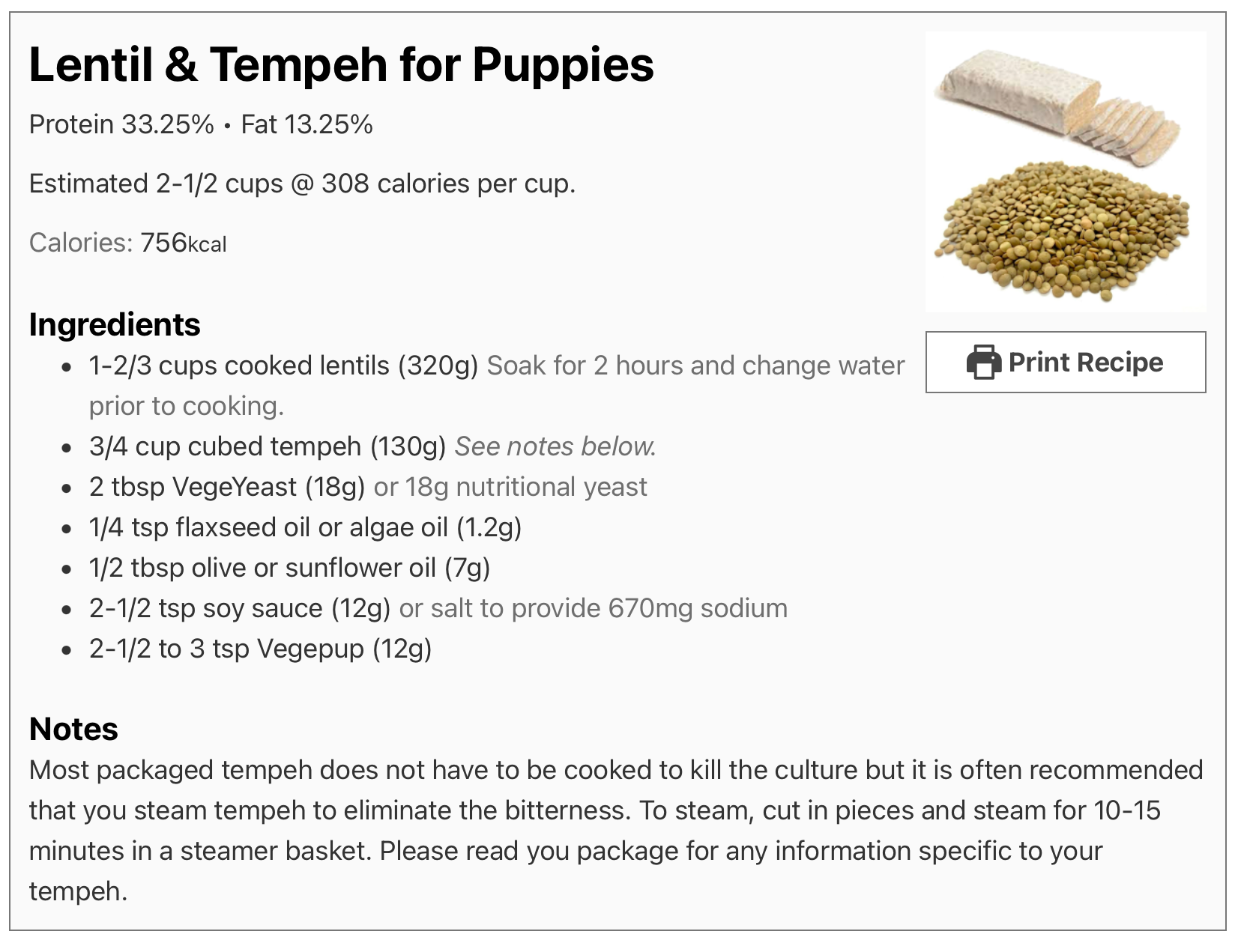
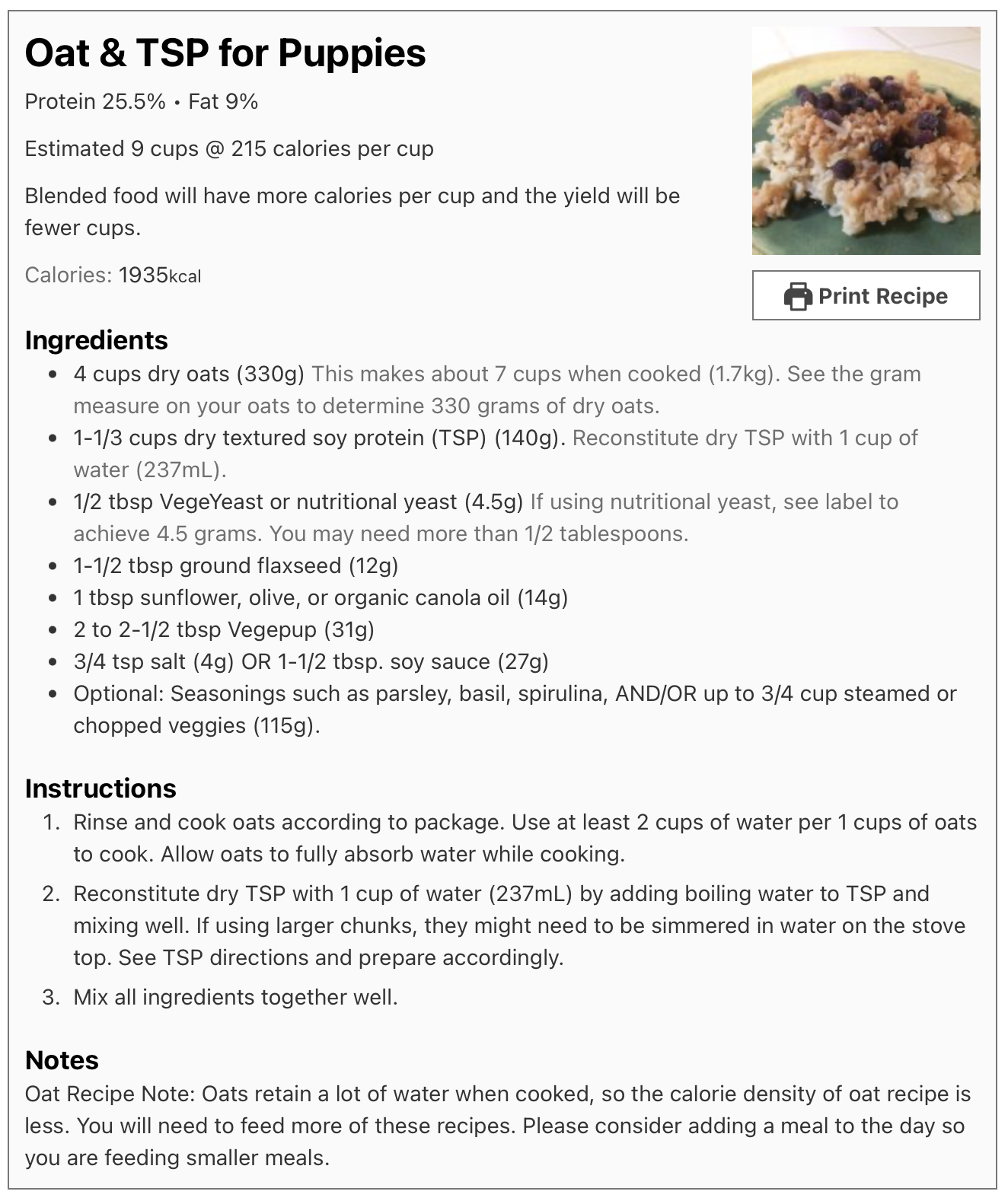
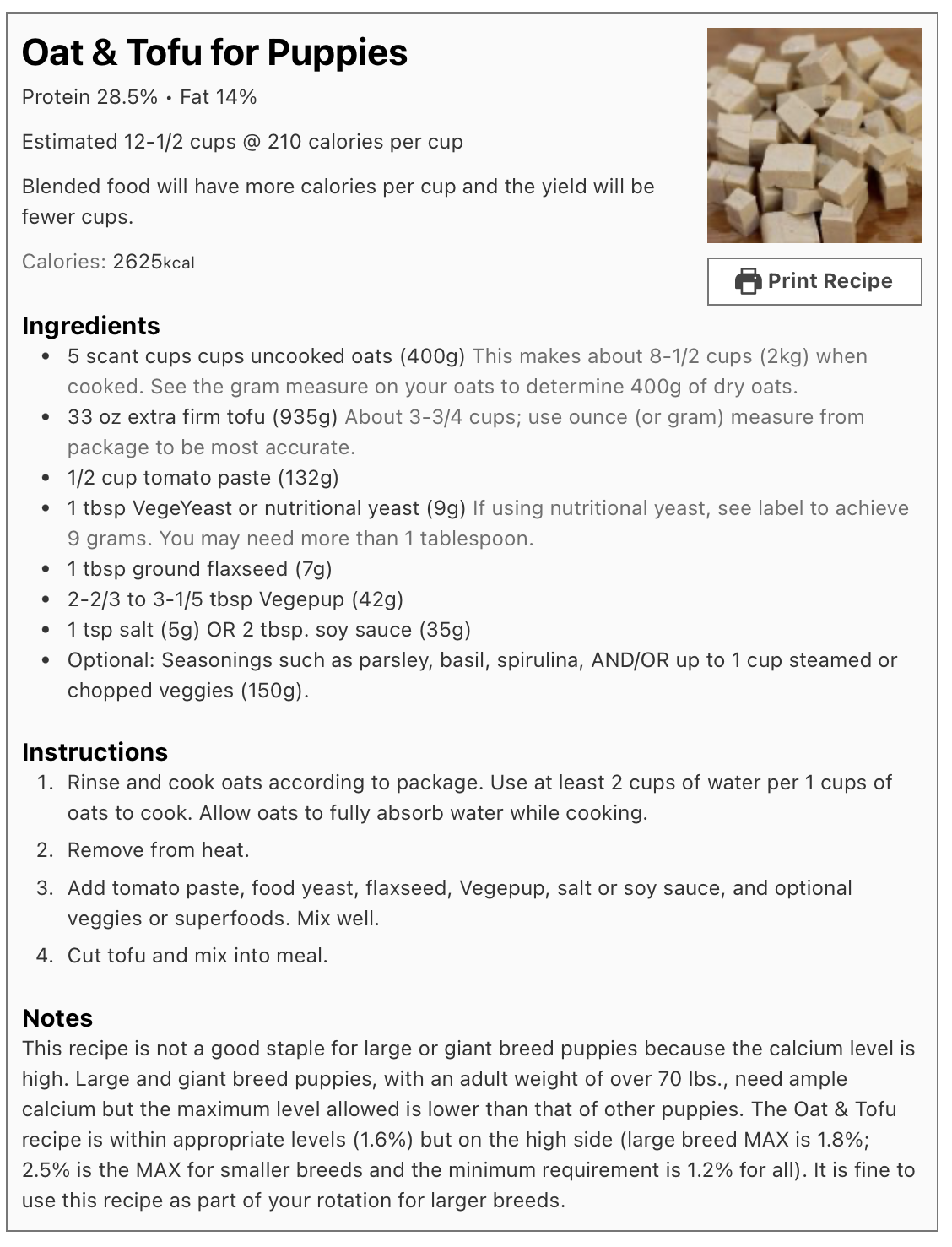
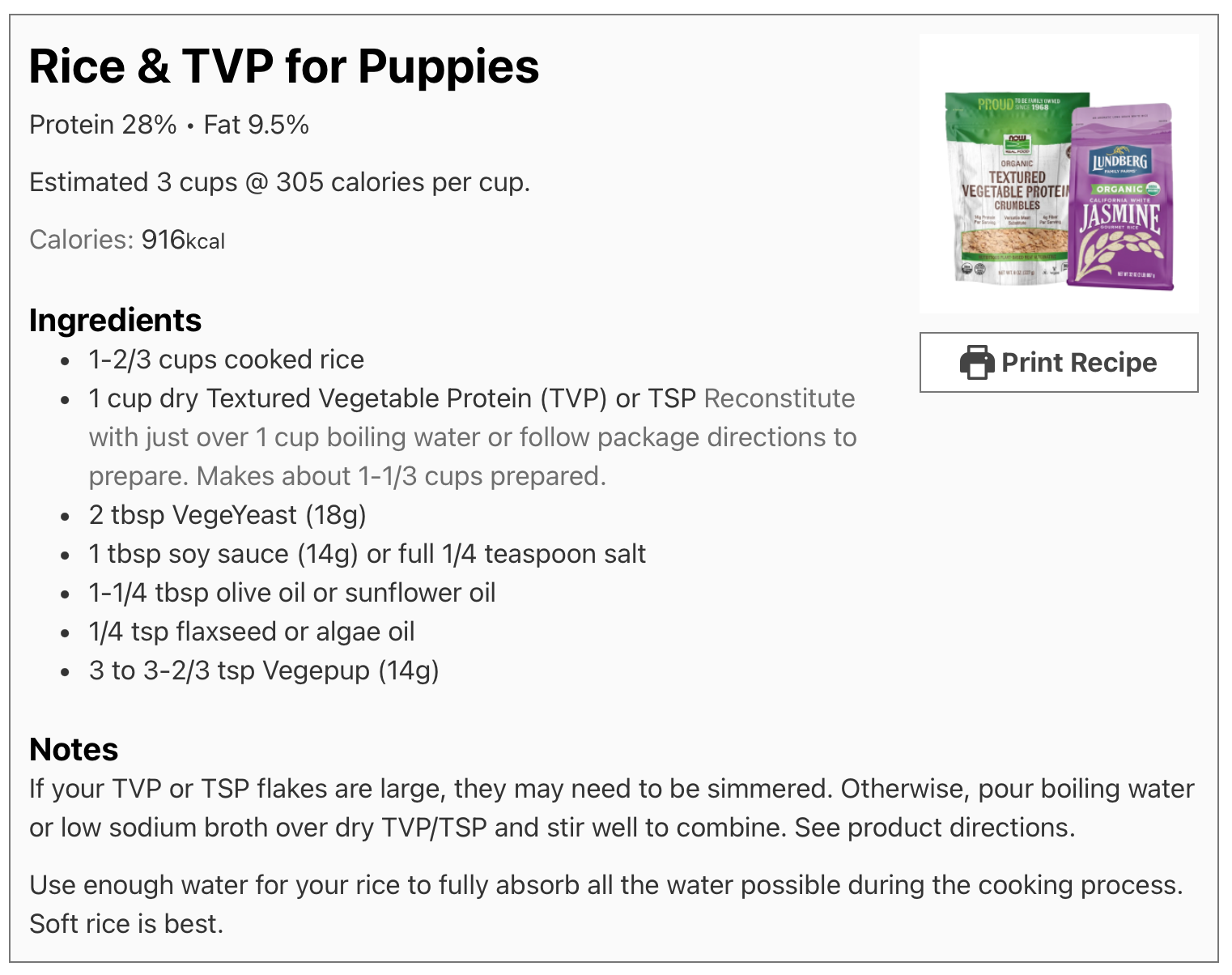
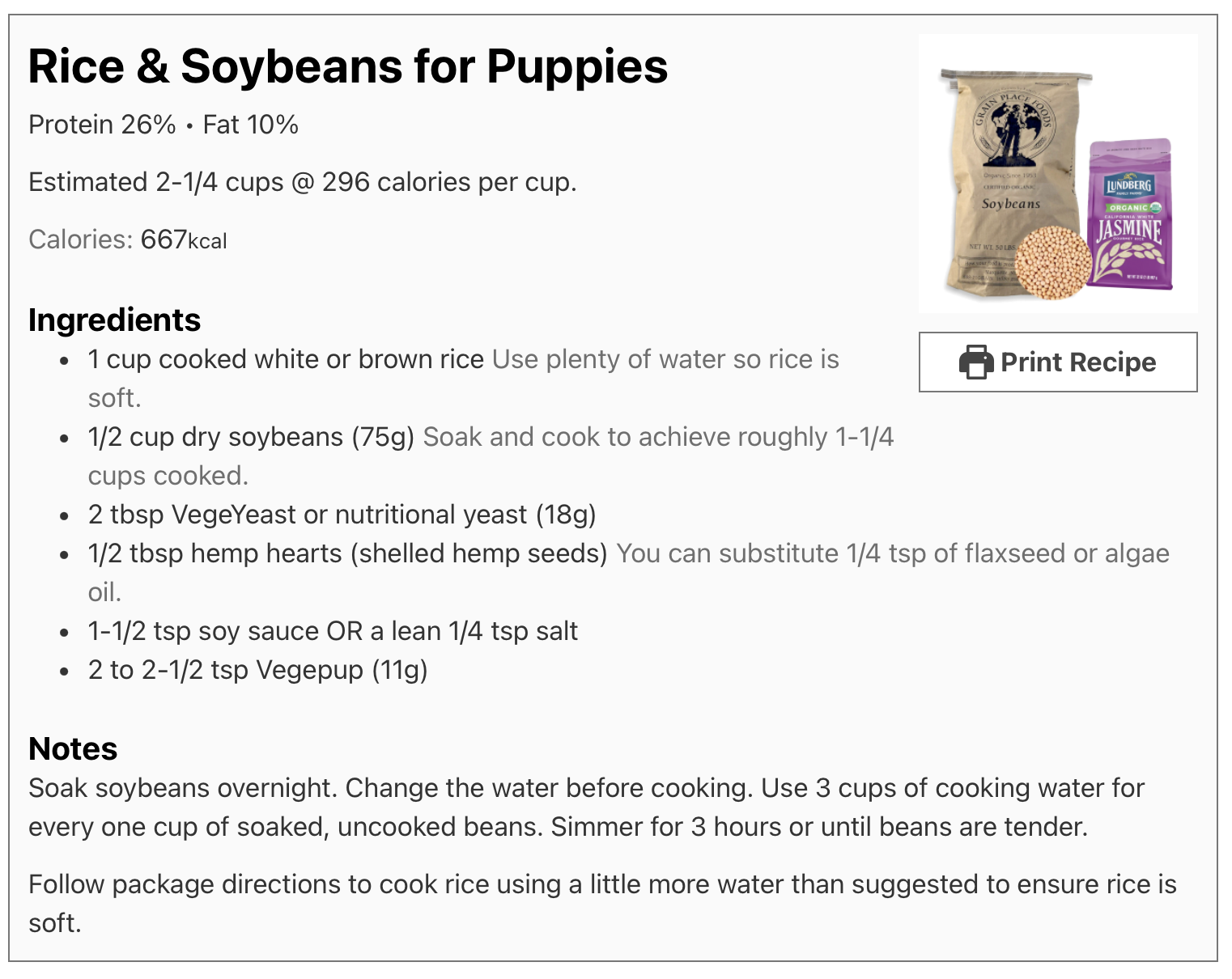
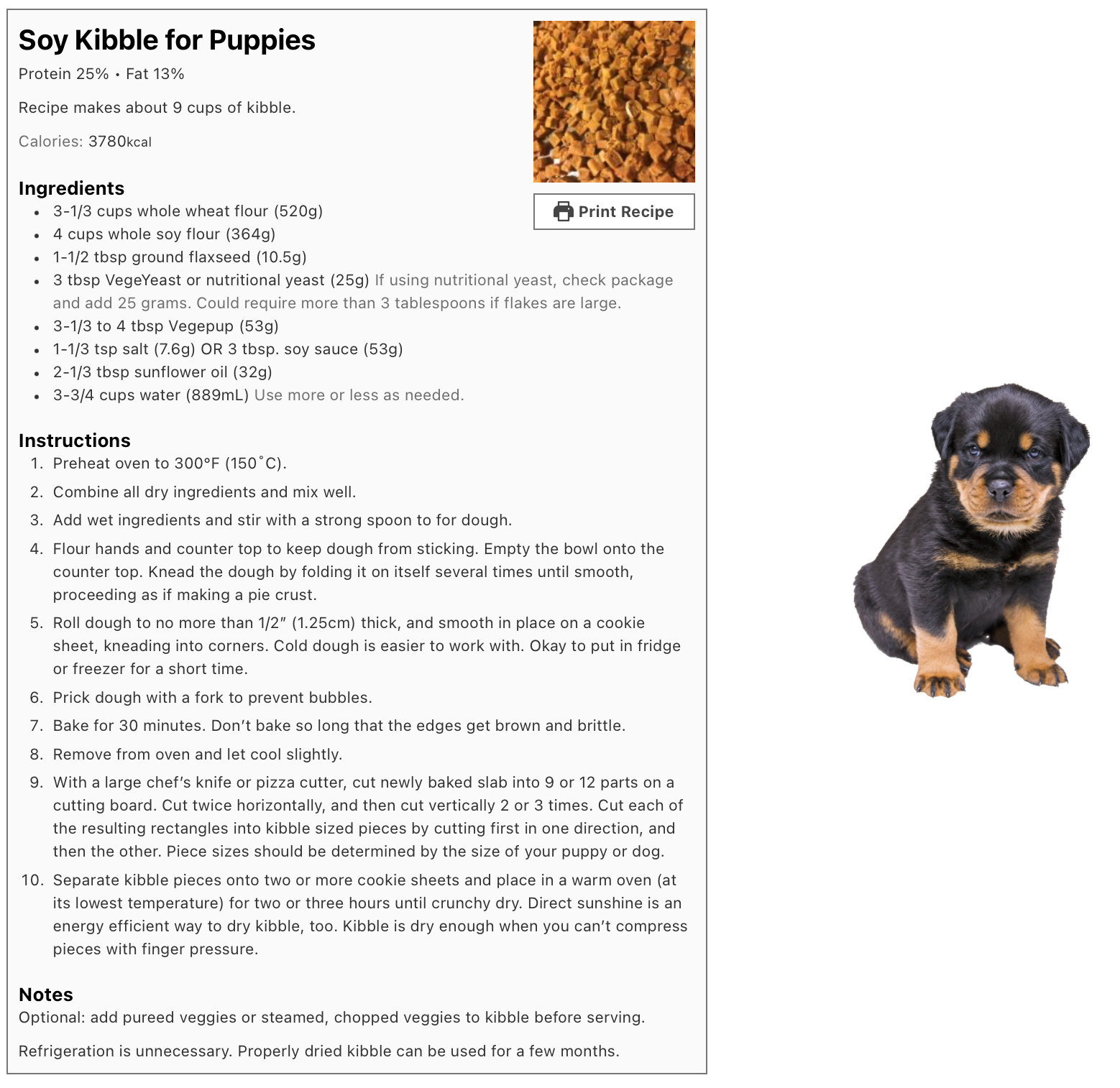
To find out how many calories per cup your home-prepared meal yields, prepare your meal and then measure how many cups your recipe made with a measuring cup. Our recipes list the total number of calories in the recipe under the recipe title (also listed in the chart below). Divide the recipe calorie total by the number of cups your recipe yields. For example, if you end up with 9-1/2 cups of food from the garbanzo recipe, your food is 299 calories per cup. [2837 ÷ 9.5 = 298.6]
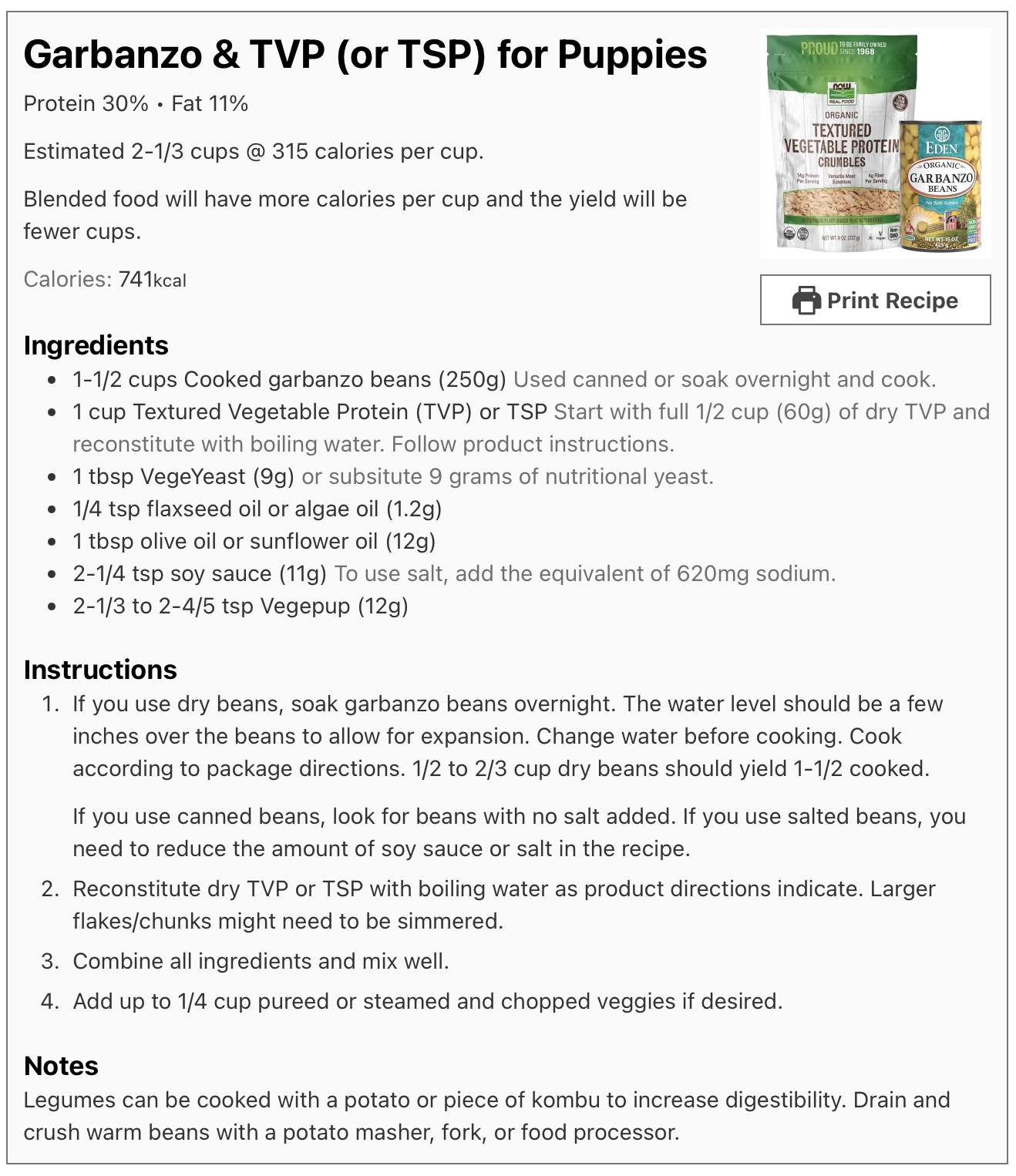
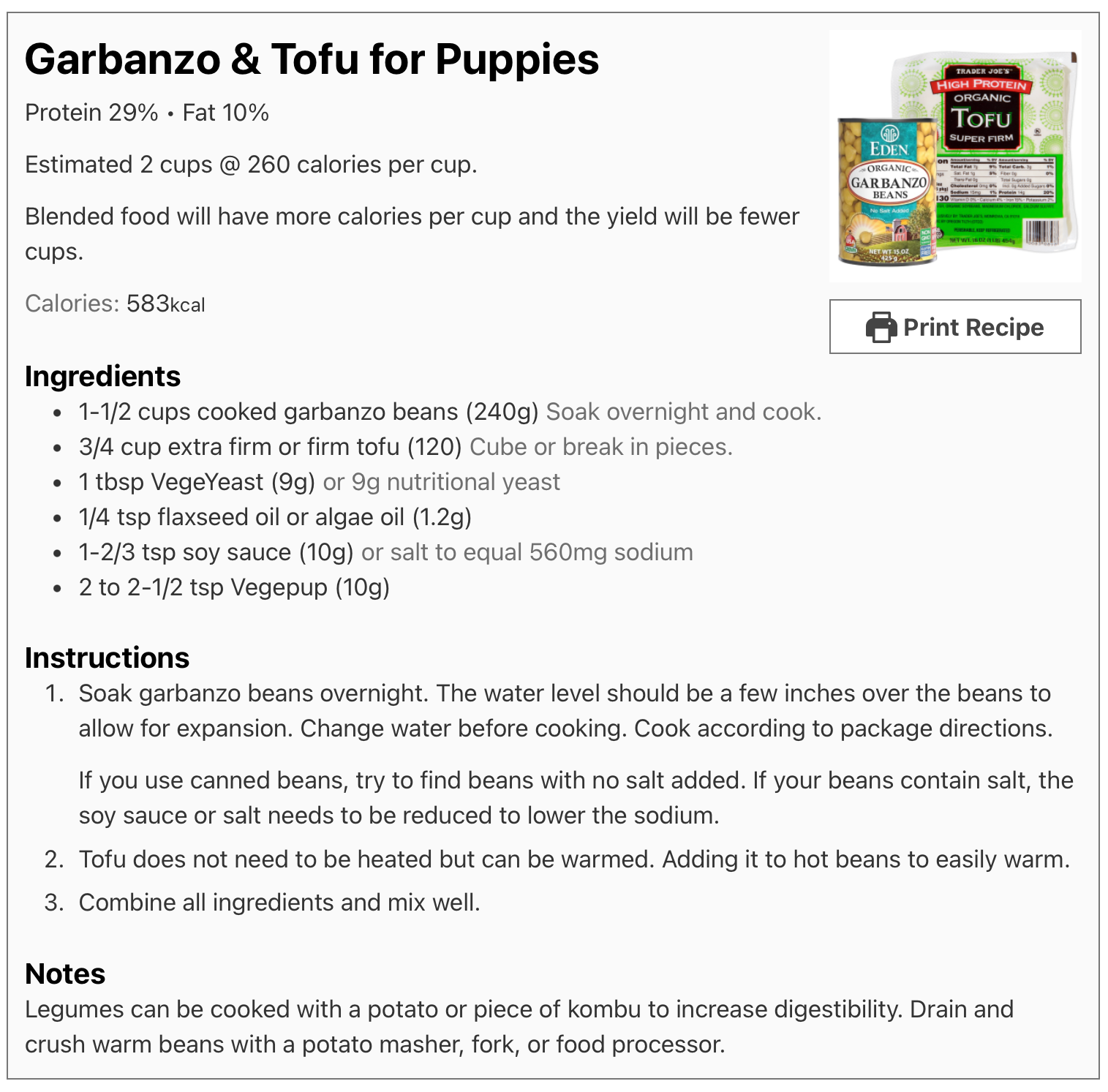
Due to variations in ingredients, the amount of water used, cook times and methods, whether you mash or puree your meals, the vegetables you add, etc., everyone is going to end up with a different volume of food from our recipes. The above method is the most accurate way to determine how much to feed. That said, each recipe below gives an estimate of how many cups it yields, and how many calories per cup, prior to blending or mashing and adding vegetables.
There are 16 tablespoons in one cup. If you’d like to find out how many calories are in one tablespoon, divide the number of calories in one cup by 16. If one cup contains 378 calories, one tablespoon contains 23.6 calories. [378 ÷ 16 = 23.6]
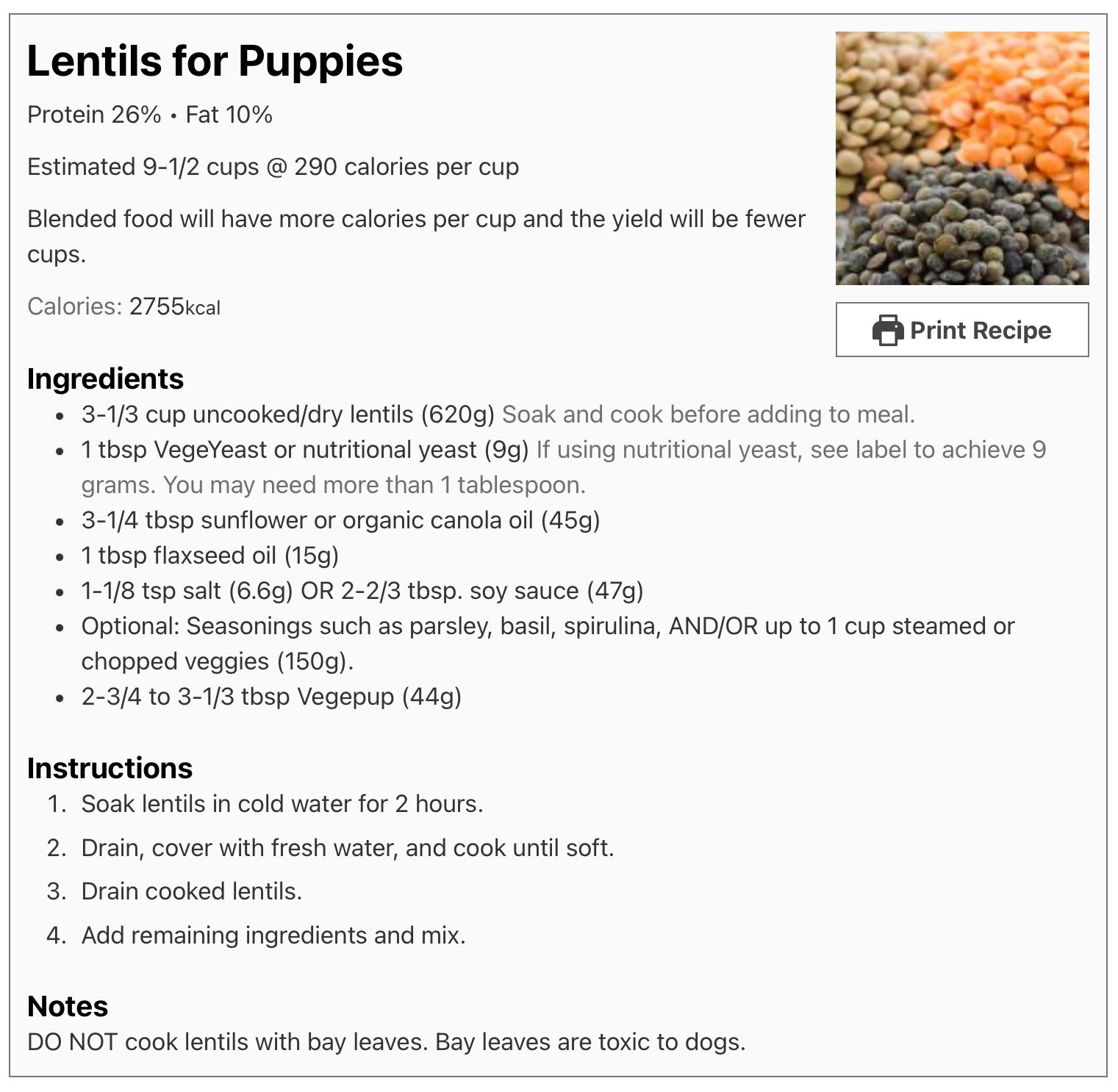
Example: If you have a 3-month old puppy who weighs 10 lbs, the above calorie calculator recommends feeding 654 calories per day. Let’s say you prepare the Lentil Recipe and end up with 9-1/2 cups of a whole lentil food. Since the recipe is a total of 2755 calories, you have 290 calories per cup.
If you were to feed your puppy this food, you’d need to feed 2-1/4 cups per day, though the amount of veggies you add will increase the amount. [654 (calories) ÷ 290 (calories per cup) = 2.25 (or 2-1/4) cups per day]
If you want to make the food easier to digest, you can blend the food in the blender and might end up with 7 cups of food. Again, the entire recipe contains 2755 calories. 2755 (calories) ÷ 7 (cups) = 393 calories per cup. Now your blended lentil recipe contains 393 calories per cup.
To feed your little one 654 calories in a day, you divide the the number of calories you want to feed by the number of calories in a cup of your food. 654 (calories) ÷ 393 (calories per cup) = 1.66 (or 1-2/3) cups per day
Please do not stress too much about this. You don’t have to have everything exactly right down to the tablespoon or calorie. If you have questions, contact us from the contact page. We are happy to help!
TRANSITION GRADUALLY
Mix a small amount of the new food in with the old food and adjust the proportions over a week or longer. You can start with up to 25% new food on the first day. Digestive enzymes are especially beneficial during the transition, while the digestive tract makes adjustments.
ORGANIC & NON-GMO INGREDIENTS
GMO (Genetically Modified Organism) ingredients and herbicides can cause gastrointestinal issues, food allergies, and more. Soy, canola, and corn that is not organic IS almost certainly genetically modified in the USA. Compassion Circle strongly recommends organic food for you and your animals!
DIGESTIVE ENZYMES
Almost every process in the body requires enzymes. Digestion is no different. Digestive enzymes are produced in the body and found in plants and raw foods. These enzymes are heat sensitive, so cooking and processing food destroys the natural enzymes. We recommend adding plant-derived enzymes (lipase, amylase, protease, and cellulase) to any cooked food. Amylase is a particularly important aid for the digestion of carbohydrates. A little raw food doesn’t supply enough enzymes to compensate for the enzyme loss in cooked food. Compassion Circle resells two great digestive enzyme prodcuts — Enzyme Miracle and Plant Enzymes and Probiotics.
VEGETABLES - YES, PLEASE!
Adding vegetables (but never onions) to your puppy’s food is ideal. A variety of veggies in the diet adds few calories, but valuable, easily-absorbed vitamins and minerals. While our recipes meet nutritional requirements without the addition of vegetables, we highly recommend adding veggies to make up about 10% of the diet. Add lightly steamed or raw veggies; pureed or chopped – carrots, broccoli, green beans, cauliflower, squash or pumpkin, tomatoes, turnips, and more. Creamed or pureed corn is a good addition to meals, as are purees with a base of kale, lettuce, and other greens. Raw apples, cucumbers, berries, and melon can be added to purees or given alone as treats.It is ideal to add purees or steamed veggies to dry kibble because this increases the water content of the food and improves urine concentration.
FOOD YEAST - VEGEYEAST
Food yeast adds high quality protein, B vitamins, and flavor while helping deter fleas. Our VegeYeast is a modified Brewer’s yeast. It is more acidic than other yeast powders, thus beneficial for the urinary health of puppies and dogs. Stir yeast powder into the food so chunks are uniformly coated.
OIL - EFAs ARE IMPORTANT
Essential Fatty Acids (EFAs) are particularly important during the growth stage. The omega-6 fatty acid, linoleic acid (LA), is especially important. Dogs and puppies can produce the other fatty acids they need with enough linoleic acid in the diet. This includes the production of arachidonic acid.
When a recipe calls for sunflower oil, it is to meet the linoleic acid (LA) requirement. This is important! The following oils are a comparable substitute for sunflower oil: safflower oil, evening primrose oil, grape seed oil, and hemp oil. If you use a different oil, understand that your dog needs 1/2 teaspoon (2.47mL) of one of the above oils for every 15 lbs (6.8kg) of body weight each day to meat the linoleic acid requirement.
Omega-3 fatty acids, specifically linolenic acid (ALA), come from the flax ingredients or algae oil in the recipes. You may substitute 2/3 a teaspoon (3.3mL) of flaxseed oil for 1 tablespoon (7g) of ground flaxseed, or vice versa. That said, it’s preferable to use algae oil for the Omega-3 portion of the diet so your puppy has readily available DHA and EPA in the diet.
Store oils in the refrigerator. Smell and taste them before use to be sure they are not rancid.
SEASONINGS
Imitation bacon bits, stevia (a sweet herb)*, imitation meat, spirulina, pureed vegetables, and favorite table scraps from your own meals increase palatability, although you’ll find it hardly necessary for palatability.
*DO NOT use xylitol in dog food. It is toxic.
TEXTURED SOY PROTEIN (TVP)
We highly recommend using organic, non-GMO soy products! Textured soy protein (TSP), also known as textured vegetable protein (TVP®) or soya chunks, is a defatted soy flour. Measure TSP (textured soy protein) before reconstituting. Flakes and granules must be reconstituted. Add 7/8 cup boiling water (207mL) to each cup of TSP (237mL) and let it absorb the liquid. Textured soy protein chunks (which are larger) may require brief simmering before ready for use. Recipe cup measures are based on 1 cup of dry TSP weighing 96 grams.
ABOUT THE RECIPES
Young puppies need 2 times more calories per pound of body weight than an adult dog. They eat more per pound of body weight (and more often) and need the added nutrients in Vegepup™. Pregnant or lactating mamas also eat considerably more than average adults. While not ideal, adult dogs who are not pregnant or lactating may eat recipes prepared with the Vegepup™ supplement. Ideally, the Vegedog™ supplement and recipes should be used for dogs 12-months of age and older.
The Vegepup™ supplement needn’t be cooked or heated. It can be added after meals are prepared, but it is best to mix the supplement into warm food. Ingredients can be prepared separately, then mixed together, or you may come up with your own method. Prepared meals can be stored in the refrigerator or freezer, with or without the supplement.

Vegepup Daily Serving Amount
Our Vegepup™ recipes have the amount of Vegepup™ factored into the recipe. If you modify our recipes, please only substitute legumes for legumes or grains for grains, and be mindful of the protein content in your puppy’s diet; it should be roughly 30%.
See the adjacent serving size chart to determine the daily serving size for your puppy’s age and weight. Mix the daily serving amount into the total amount of daily food, or divide it between daily meals.
On average, recipes need 1 tablespoon (16g) of Vegepup for every 1000 calories in a recipe.